Resources: Posters

A Single-Cell Platform for Longitudinal Monitoring of Protoplast Physiology and Transcriptomics​

April 12, 2026

AGBT Agriculture Meeting

James Walker, Ph.D., The Salk Institute for Biological Studies

Keywords: Plant biology, AgBio, Protoplast development, Stress response, Single-cell plant genomics
Keywords: Plant biology, AgBio, Protoplast development, Stress response, Single-cell plant genomics

Presented by:
James Walker, Ph.D., The Salk Institute for Biological Studies
Presented at:
April 24, 2026

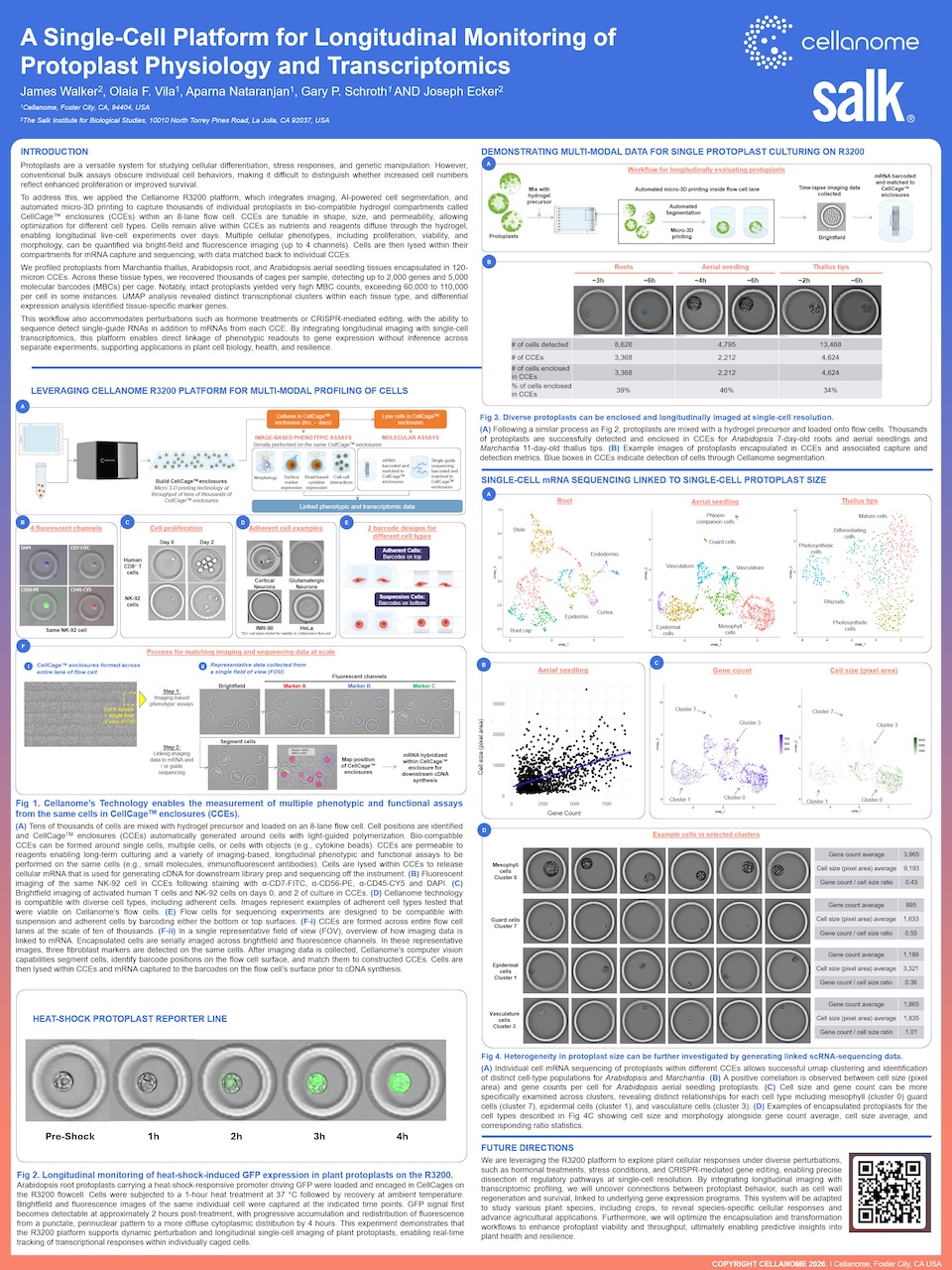
Highlighting a novel workflow for plant functional genomics, this poster demonstrates the longitudinal monitoring of intact protoplast physiology and transcriptomics. By preserving cell health in a controlled microenvironment, the platform reveals dynamic developmental trajectories and physiological changes at single-cell resolution, avoiding the stress-induced artifacts of traditional tissue dissociation.

Case Study: Functional Profiling of Microglia in Neuroinflammation

Link microglial behavior to gene expression at single-cell resolution, for insight into neuroinflammation, drug response, and immune dysfunction in CNS disease.

View Case Study Details

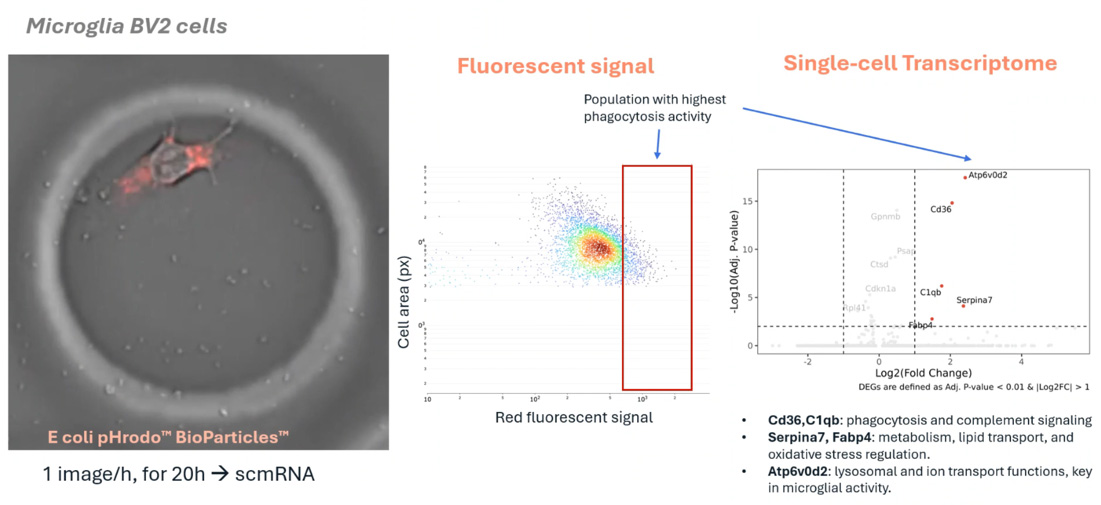
Researchers used the Cellanome R3200 to enclose individual microglia with fluorescent particles and track phagocytosis over 12 hours via fluorescent imaging. Each cell’s transcriptome was then sequenced, linking activity levels to gene expression.  

What they found: 

High-activity microglia upregulated genes in complement signaling, lipid metabolism, and lysosomal function–key pathways in neuroinflammation and repair. 

Why it matters: 

This approach overcomes key limitations in standard assays by capturing phagocytic function and gene expression in the same individual cells without dissociation, pooling, or inference. It enables a direct, scalable readout of immune heterogeneity, and reveals the transcriptional programs driving effective or impaired microglial responses.  

What’s next: 

Extend to co-cultures by layering enclosed microglia over intact neuronal networks. Study how cell-cell interactions shape phagocytic behavior and fate. Combine with cytokines, CRISPR libraries, or immunotherapies to generate time-resolved, multi-modal datasets that can be used for MoA analysis, early biomarker discovery, and AI-guided modeling in CNS disease. 

Case Study: Modeling Synapse Formation and Developmental Trajectories in 3D

Track development, function, and gene expression in intact neurospheres, a human-relevant 3D model increasingly vital as regulators move away from animal studies.

View Case Study Details

Stem-cell-derived neurospheres offer a robust 3D model of early brain development, but standard assays disrupt their structure and miss critical dynamics.  

Approach:

Using the Cellanome R3200, the research team explored,

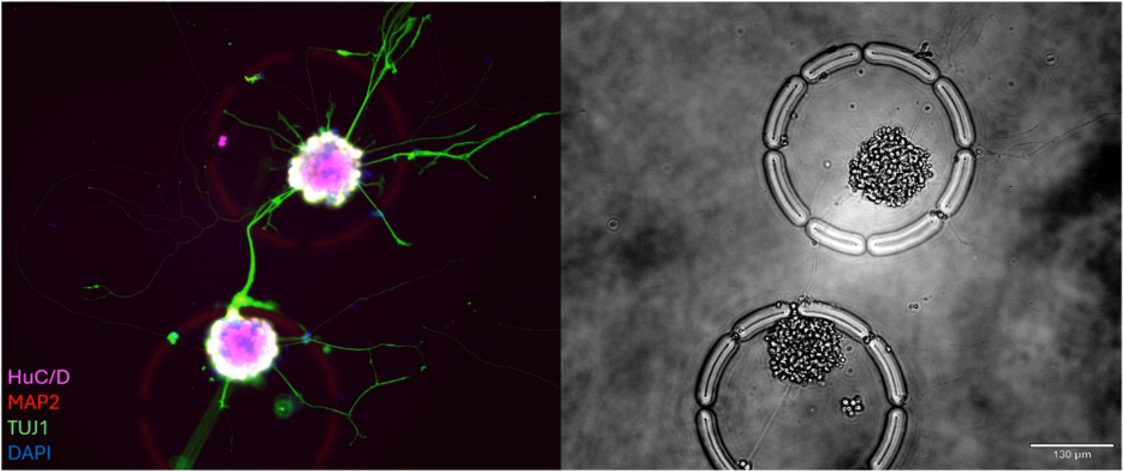
  • Hundreds of intact neurospheres (100–200 cells each) were cultured inside individual CellCage™ enclosures. 
  • Axon extension, synapse formation and calcium activity were tracked over multiple days. 
  • End-point RNA-Seq was linked back to each neurosphere’s functional behavior. 
  • UMAP clustering revealed lineage-specific gene programs, validated by fluorescent markers.  
What's next:

This lays the groundwork for CRISPR-based multimodal screens to probe mechanisms of development, degeneration, and repair within preserved 3D architecture. 

Why it matters:

As the FDA and others move to reduce reliance on animal models, human-relevant in vitro systems like this are increasingly essential. 

FAQ's

Why is longitudinal monitoring essential for protoplast research?

Protoplasts are highly sensitive to environmental changes. Longitudinal monitoring enables the observation of real-time physiological shifts and developmental transitions, providing a dynamic view of plant cell health and response that single-point assays cannot provide.

How does the platform improve plant transcriptomic studies?

Traditional plant transcriptomics often requires tissue dissociation, which can induce stress and alter cellular data. This platform enables the study of intact protoplasts in a controlled environment, linking continuous physiological observations to high-resolution transcriptomic insights.